
How to Read Betting Odds — Fractions, Decimals & Value
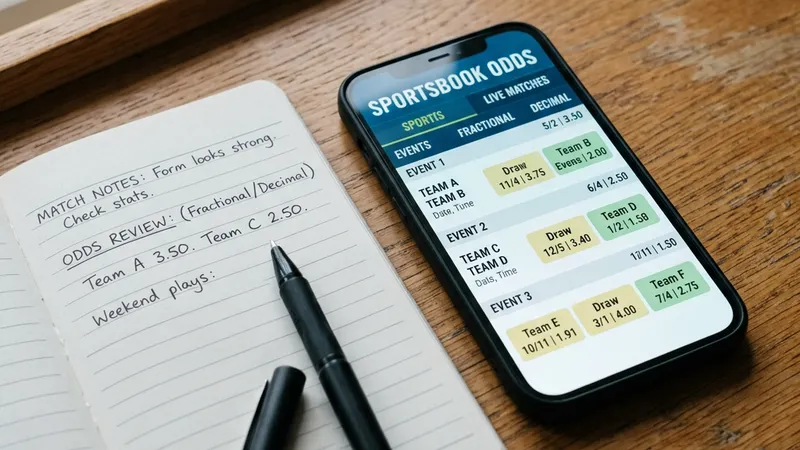
Before you can bet well, you have to read a price properly — and the odds you see at an Irish book come in two formats that trip people up. Once you can read both fractions and decimals, work out a return in your head, and spot when a price is bigger than it should be, you are betting on information rather than hope. Here is the plain-English version.
Fractional Odds
Fractional odds — 5/2, 6/4, 10/1 — are the traditional Irish and UK format, and they show your profit relative to your stake. 5/2 means for every €2 you stake, you win €5 profit (plus your stake back). So a €10 bet at 5/2 wins €25 profit and returns €35 in total. Evens, written 1/1, doubles your money: stake €10, win €10 profit, get €20 back. Anything shorter than evens — like 4/6 — means you stake more than you win: €6 to win €4.
Decimal Odds
Decimal odds — 3.50, 2.50, 11.0 — are the format most online punters now prefer, because the maths is effortless. The decimal number is your total return per €1 staked, stake included. Multiply your stake by the odds and you have your return: €10 at 3.50 returns €35, full stop. No adding the stake back, no fractions. The same 5/2 from the example above is simply 3.50 in decimal — identical price, easier sum.
Converting Between Them
You rarely need to convert by hand — every Irish book lets you switch format in the settings — but the link is simple: a fraction like 5/2 becomes decimal by dividing (5 ÷ 2 = 2.5) and adding 1, giving 3.50. Evens (1/1) is 2.0. 10/1 is 11.0. Pick the format you find clearer and leave it; the price your book is offering is exactly the same either way.
Odds and Probability
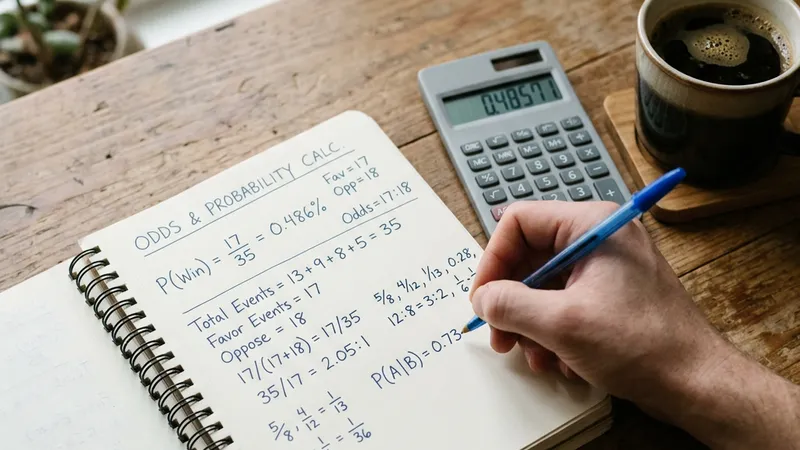
Here is the part that turns reading odds into betting well. Every price implies a probability. Decimal odds of 2.0 (evens) imply a 50% chance; 4.0 implies 25% (1 divided by 4); 1.5 implies about 67%. The bookmaker builds a margin in, so the implied chances across a market add up to more than 100% — that margin is how the book makes money. Knowing roughly what chance a price implies is the foundation of judging whether it is fair.
The Overround — How the Book Builds Its Margin
Once you can turn a price into a probability, you can see how the bookmaker makes its money. Take a two-way market — say a match where both sides are evens, 2.0 in decimal. Each price implies a 50% chance, so the two add up to exactly 100% in a perfectly fair market. But a book will not offer 2.0 and 2.0; it shaves both to, say, 1.90, and 1.90 implies about 53%. Add the two together and you get roughly 106% — that extra 6% is the overround, the built-in margin the book keeps whatever happens. Every market carries one, and the bigger the field the bigger it tends to be. You cannot avoid the overround, but you can shrink the slice you pay by comparing books: the operator with the tightest margin on a given market is quietly giving you a better price on the same bet.
Why Odds Move
A price is not fixed — it breathes from the moment a market opens to the off. Two things move it. The first is money: when a lot of punters back one side, the book shortens it to balance its liability, which is why an early price can be bigger than the one available at kick-off. The second is information: a team-sheet dropping, a key player ruled out, heavy rain rolling in over a pitch. The practical lesson is to take a price when you think it is value rather than waiting for it to drift, because you cannot rely on it still being there. On racing, best odds guaranteed softens this — take an early price and you are paid at the bigger of that or the starting price — which is exactly why it is worth using.
Each-Way Odds and Place Terms
Each-way betting trips up more newcomers than anything else, because the price you see is only half the story. An each-way bet is two bets — one on the selection to win, one on it to place — so a €10 each-way bet costs €20. The place part pays at a fraction of the win odds, and the fraction and the number of places are set by the market. A common racing example is "1/5 odds, 4 places": back something at 20/1 each-way and the place portion pays at one-fifth of 20/1, which is 4/1, if it finishes in the first four. Read those terms before you bet — at a big-field race the difference between four places and six on the same horse is the difference between collecting and tearing up the slip.
Spotting Value
Value is the whole game. A bet is value when the price is bigger than the real chance of it happening — when you think a team has, say, a 50% chance but the price implies only 40%. Backing winners is not the goal; backing value is, because over hundreds of bets the value is what shows a profit. It is a judgement and never a certainty, but it is the difference between betting with information and betting on a feeling. And because different books offer different prices on the same outcome, comparing — Paddy Power against bet365 — is how you make sure you are taking the value when you find it.
A Worked Value Check — and the Odds-On Trap
Put it all together with a quick check. Say a book prices a hurling county at 1.91 to win — that implies roughly a 52% chance. If your own read of the form, the team news and the going says they are closer to a 60% shot, the price is bigger than the true chance, and that is a value bet worth taking. If you think they are really only a 45% chance, the same price is poor value and a pass — even though they might still win the match. That gap between your honest estimate and the implied figure is the whole craft. It also explains the odds-on trap: a heavy favourite at 1.40 implies about 71%, so to profit backing it you must be confident the real chance is higher still, and piling money onto short odds-on prices "because they will win" is how bankrolls quietly drain away. Whether a price is odds-against — bigger than evens, the underdog — or odds-on — shorter than evens, the favourite — the only question that matters is whether it beats your own estimate of the chance.
Once you can read a price, the accumulator is the next thing to understand — how those odds multiply across a multi-leg bet. And for the rules of the game, start with our guide to whether online betting is legal in Ireland.
Reading odds well is a skill that protects your money — take your time, compare prices, and never bet more than you can afford because a price looks tempting. 18+. If gambling stops being fun, GamblingCare.ie offers free, confidential support on 1800 936 725.
Frequently Asked Questions — Reading Betting Odds
What is the difference between fractional and decimal odds?
They are two ways of showing the same price. Fractional odds (5/2) show your profit relative to your stake. Decimal odds (3.50) show your total return including the stake. Most Irish books let you switch between them in the settings — pick whichever you find clearer; the price is identical.
How do I work out my return from decimal odds?
Multiply your stake by the decimal odds. A €10 bet at 3.50 returns €35 in total — your €10 stake back plus €25 profit. Decimal odds make this simple, which is why most online punters prefer them: total return is just stake times price.
What does it mean for a price to be value?
A price is value when it is bigger than the true chance of the outcome. If you judge a team has a better chance of winning than its odds imply, that is a value bet — and backing value consistently, not backing winners, is what makes betting pay over time. It is a judgement, not a certainty.
See our full list of verified licensed Irish betting sites — every bookmaker checked against the GRAI Licence register.
Best betting sites in Ireland →18+ only. Please gamble responsibly.
Free help available: gamblingcare.ie | Helpline: 1800 936 725
Related Posts